 China International Pet Show
PhD Graduate from Zhejiang University Earns Over 10 Million Yuan in 1.5 Months by Selling Pet Translators Overseas
How can a less-than-six-month-old startup tap into the brand-new global hot sector of the pet economy in such a short span of time?
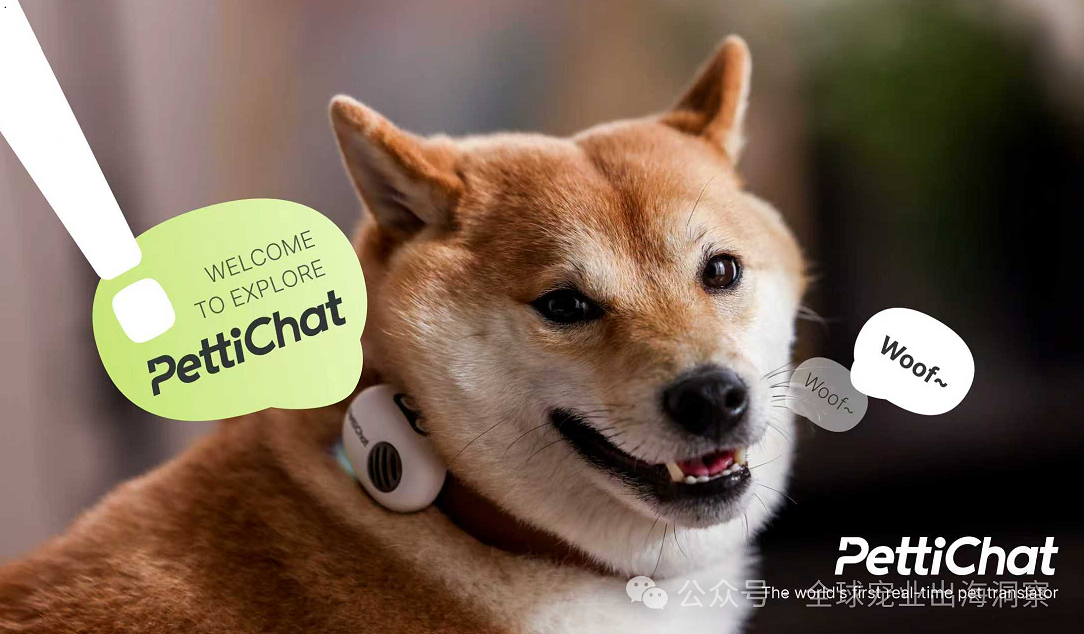
Recently, an intelligent pet collar developed in Hangzhou, China, has gone viral across overseas social media platforms.
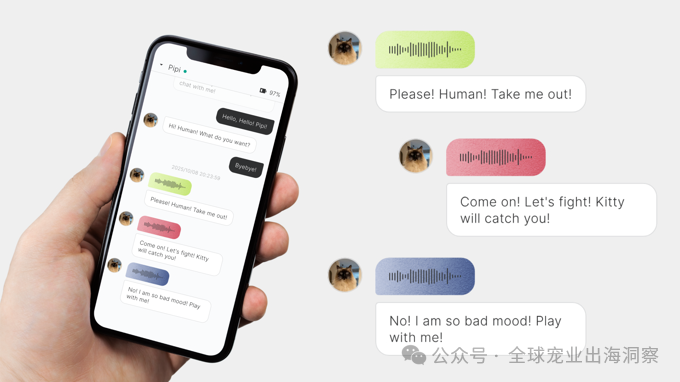
Dubbed PettiChat, or Meng Xiaoyi in Chinese, it is the world’s first real-time AI pet translation device. Weighing merely 27 grams, the compact gadget clips onto collars for cats and dogs. It instantly translates pets’ vocalizations into human language in roughly one second, letting owners know whether their feline companion is hungry, irritated, or simply craving affection.
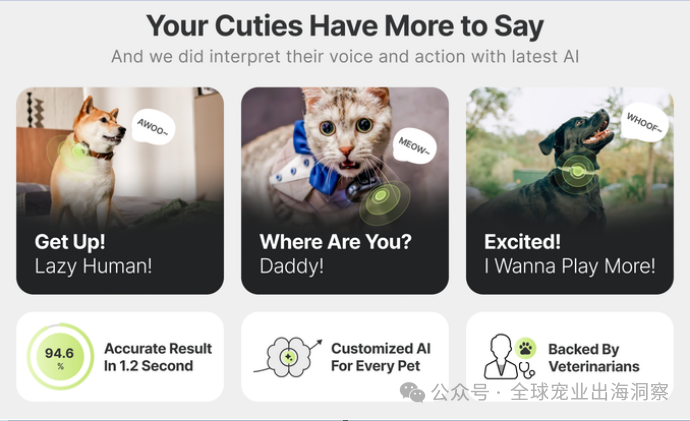
According to official disclosures, PettiChat launched globally this May. In just a month and a half, global orders surpassed 20,000 units, with shipments to over 30 countries and regions. Deliveries began in June, bringing cumulative revenue to more than 10 million RMB. It is undoubtedly a thriving cross-border export business.
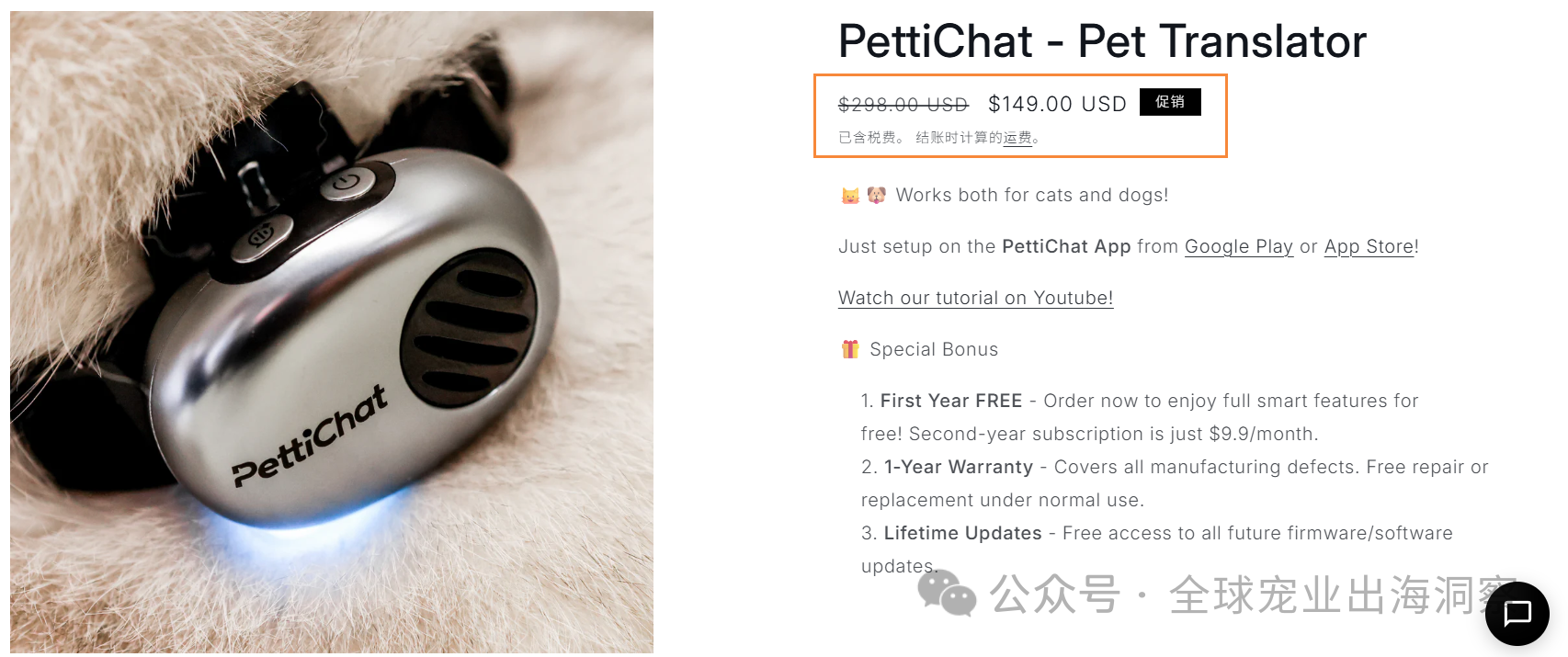
Global Pet Industry Export Insights learned that, in terms of pricing across sales channels, the product retails at $149 on its official overseas website. Meanwhile, after platform discounts on a major domestic e-commerce site, it is priced at roughly 766 RMB as of July 6, offering a more affordable option for local buyers.
Rooted in the Wish to Speak With Our Pets
To grasp why PettiChat has become a smash hit, we first need to address a question lingering in every pet owner’s mind: When I talk to my pet, can it actually understand me?
The truth is, most owners “converse” with their cats and dogs every single day. They ask if their pet is hungry, praise it for being well-behaved, or grumble about it tearing up the house. Yet pets only respond with a meow or bark, a glance, or a flick of their tail. Owners can never tell for sure whether their pet is happy or annoyed, craving playtime or alone time.
This frustration of longing to understand pets yet being unable to decode them knows no borders. Pet owners across the globe have long sought a way to interpret their companions’ true emotions. It is these simple yet widespread emotional pain points that gave birth to PettiChat.
Global Pet Industry Overseas Insights reported that Li Jingyuan, founder of PettiChat, holds a PhD in Artificial Intelligence from Zhejiang University. The core team members are alumni from top universities including Zhejiang University and the National University of Singapore, with interdisciplinary expertise in large AI models, edge computing and animal ethology.
Instead of developing flashy, gimmicky functions, the team poured all their energy into one single goal: enabling pets to “speak”.
The concept of pet translation dates back to 2002, when a Japanese toy firm launched BowLingual, which was little more than an entertaining novelty back then.
According to Li Jingyuan, the fundamental barrier to viable pet translation in the past lay in immature technology. Pet vocalizations occur instantaneously; relying on smartphone apps to record sounds fails to capture most authentic real-time data.
What makes the task even more challenging is that pets’ vocalizations, movements, postures and surrounding environmental context must be analyzed collectively to accurately interpret their emotions and intentions. For this reason, dedicated hardware is the viable solution—only a wearable device attached to pets can continuously capture authentic real-world behavioural data.
The project was initiated in 2025 and underwent nearly a year of intensive refinement. In January 2026, Hangzhou Mengxiaoyi Technology Co., Ltd. was officially established. That March, the company closed a $1 million angel round co-invested by Ofound Angels (ZJU Alumni Angel Fund) and Huadan Angel Investment.

While the funding sum is modest, for a team merely three months old, it signals two clear takeaways from investors: first, the product boasts a solid technical moat; second, genuine market demand exists overseas.
The product was unveiled in April and hit the market in May. It took less than half a year from the company’s founding to rack up massive global orders.
The Complete System for Understanding Pets
Despite its ultra-lightweight build, PettiChat clips onto collars with barely any perceptible weight—yet the technology packed inside is remarkably sophisticated.
On the hardware front, PettiChat’s core capability is not simply translating every bark or meow word-for-word into human speech. Instead, it identifies pets’ real-time emotions and intentions. The device is equipped with a voiceprint sensor and a 6-axis gyroscope: the former captures vocal sounds, while the latter tracks bodily postures and movement trails. Cross-referencing these two sets of data enables accurate analysis of a pet’s state.
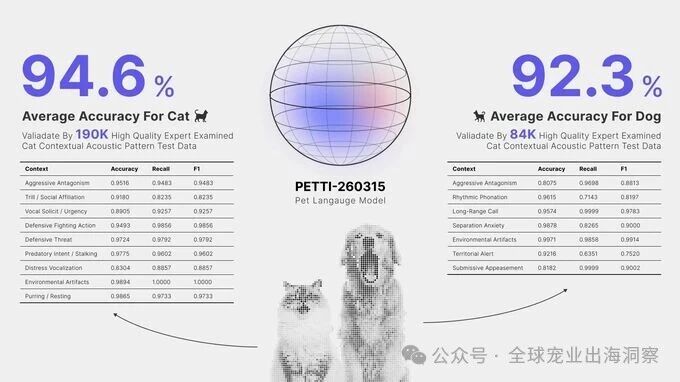
From a software perspective, PettiChat collaborated with the College of Animal Sciences, Zhejiang University, to build a million-scale pet voiceprint large model. The team collected over 5 million raw pet vocal samples in total, among which 1.54 million were manually labeled one by one by animal ethology specialists. Labels cover nearly every emotion pets convey, ranging from hunger and anxiety to territorial warning and separation distress.
The product delivers impressive test results. Official data shows that under laboratory conditions, the emotion recognition accuracy reaches 94.6% for cats and 92.3% for dogs.
Furthermore, the device continuously collects behavioral data from pets, which is then fed back to retrain the AI model—making its recognition increasingly accurate with every use. R&D planning is already underway for an early pet health warning feature in the next-generation product. In other words, beyond translating emotions, the future iteration will alert owners in advance if their dog or cat is feeling unwell, alongside targeted care recommendations.
Once this feature goes live, PettiChat will evolve far beyond a mere translator, transforming into a wearable health steward attached to your pet.
Explosive Growth Within Six Weeks
Market enthusiasm for PettiChat has translated into tangible sales figures.
For its overseas market expansion, PettiChat launched its debut campaign on Kickstarter, a crowdfunding platform. To date, the project has garnered support from 912 backers, raising more than $151,000 in total—over 30 times its original funding goal.
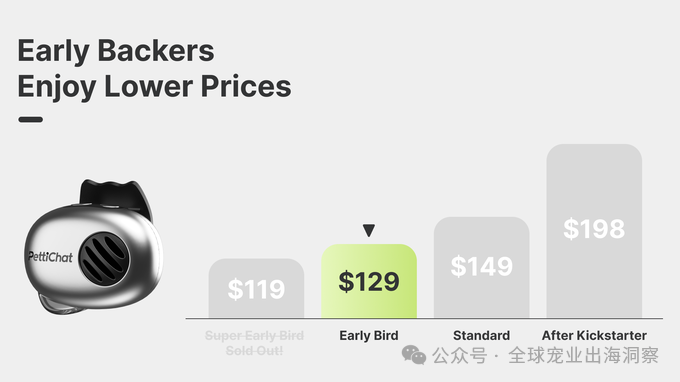
During the crowdfunding phase, the product was priced at $119 for early backers, with the standard version retailing at $149. Following the close of the crowdfunding campaign, the price was adjusted upward to $198. Kickstarter has also honored the product with its official "Project We Love" badge.
The domestic market has also witnessed an enthusiastic response. By the end of May 2026, the product had once claimed the top spot on the e-commerce platform’s bestseller ranking for smart social entertainment accessories.
Before its official launch, PettiChat had already gained widespread acclaim. In April 2026, it was named to Hangzhou’s "Top 8 Local Pet Industry Brands" list. The following month, it received the title of "New Tech Specialty Product of Hangzhou", and its industrial design was honored with the Red Dot Design Award from Germany.
In June, PettiChat rolled out a cross-industry collaboration with Rokid AI Glasses. Integrated with the Meng Xiaoyi AI agent, the partnership brought pet translation functionality to smart eyewear. This was a shrewd strategic move, signaling to the market that PettiChat is far more than a standalone hardware device — it represents versatile AI capabilities adaptable to diverse smart terminals, unlocking vast potential for ecosystem expansion.

Riding No Fad: Surging Authentic Market Demand
The pet AI track has been heating up steadily since 2026. Over the first six months alone, more than 10 pet tech startups secured financing rounds of Pre‑A stage and above.
Previously, Traini, another pet emotion AI firm, rolled out a comparable AI smart collar and raised over $7.5 million in funding. It is foreseeable that, as large language model technology matures and the global trend of anthropomorphic pet ownership deepens, AI pet hardware exports will emerge as a promising new path for Chinese tech brands.
PettiChat’s journey has only just begun, as it strives to break down the invisible barrier separating humans and their companion animals.
The above content is sourced from Global Pet Industry Insights. Any opinions expressed in the republished material are solely those of the original author and are intended for informational purposes only.
Copyright © 2008-2026 | China Great Wall International Exhibition Co., Ltd.